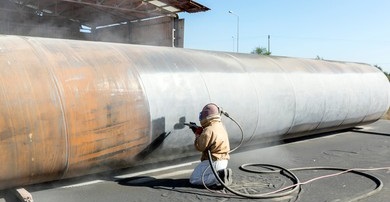
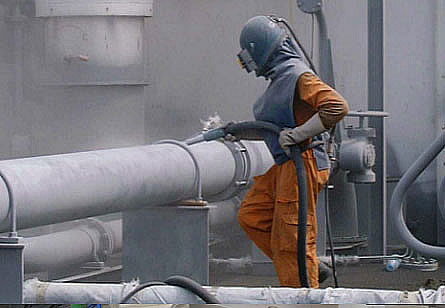
Sandblasting leverages the abrasive properties of sand to create smoother surfaces with fewer physical imperfections and flaws. It’s no secret that sand is rough and gritty. Because of these properties, it’s able to wear away at excess or unwanted material on a surface. Sandpaper, for example, contains many individual particles of sand. When rubbed against a surface, the sand removes some of the top-layer material, thereby creating a smoother texture. Sandblasting works the same way except it involves the use of highly pressurized sand.
How Sandblasting Is Performed
The first step to performing sandblasting is pouring the sand into the sandblasting machine. Sandblasting machines have a chamber on top in which the sand is poured. The sandblasting machine is then connected a conventional air compressor that, when activated, propels the sand out through a handheld nozzle. Depending on the settings, the pressure of the sand may be anywhere from 50 to 130 pounds per square inch (PSI).
The sand is then “blasted” across the surface, and because of its abrasive properties, the sand is able to create a smoother surface. Concrete, for example, is often sandblasted. After the concrete has been poured and allowed to dry, it’s treated with sandblasting. The process removes some of the excess material on the concrete, which in turn makes it smoother.
There are Two Types of Sandblasting Processes:
Water-Driven- It is applied for reducing surface deterioration, most commonly water driven process is used for brick or concrete surfaces preparation.
Air-Driven – This process is best suited for metal surfaces, to prevent moisture buildup and avoid water intrusion in the surface.
Sandblasting is the process of propelling abrasive by using the pressurized liquid or compressed gas as propellant. There are many generic terms for this process that is generally related to the sandblasting abrasive media used for this process. Here are the details of abrasive materials.